

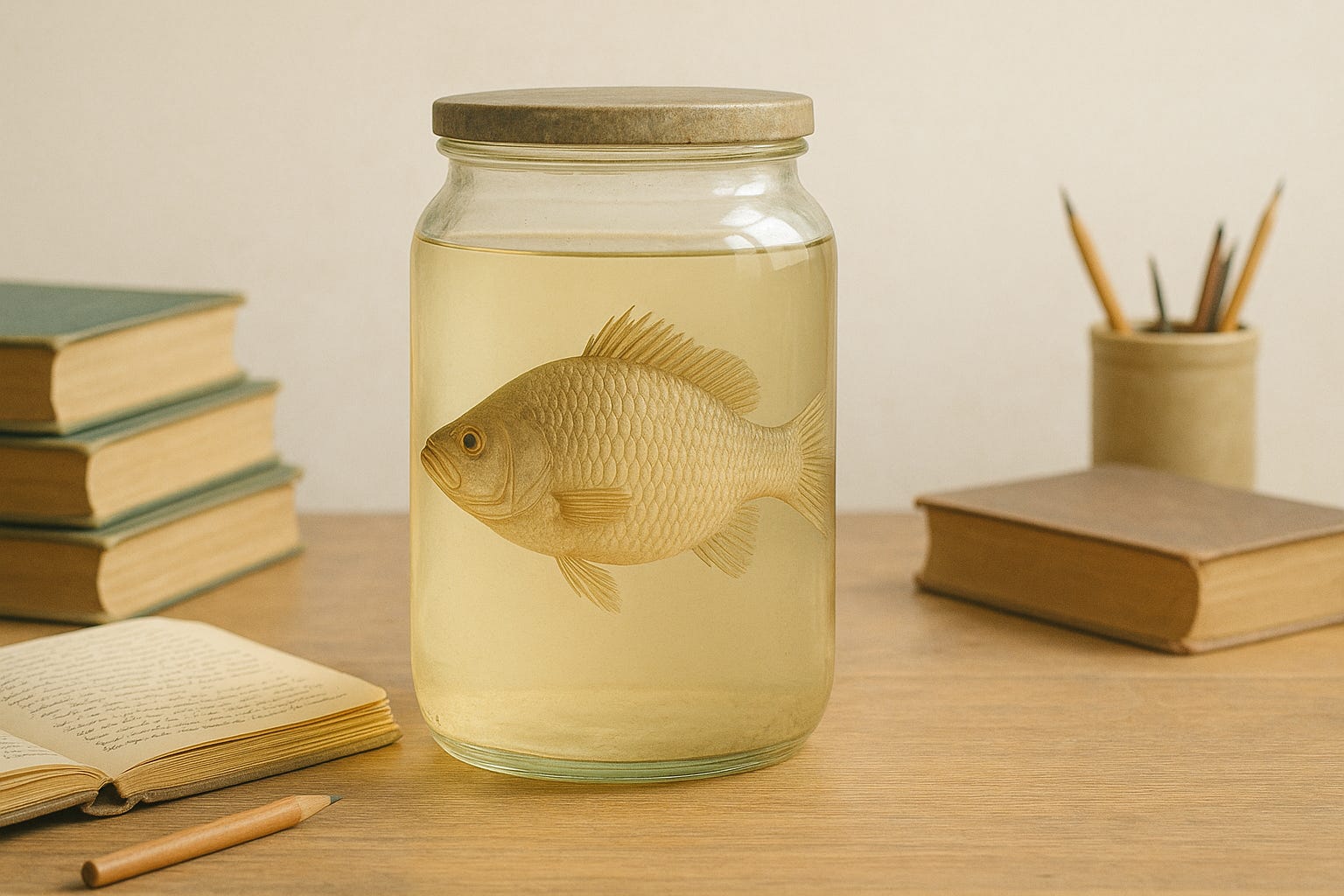
When Samuel Scudder arrived at Harvard to study natural history under the great Professor Louis Agassiz, he expected something dramatic—perhaps a dissection on day one.
Instead, Agassiz handed him a preserved fish in a jar of yellow alcohol.
"Look at your fish," he said, then quietly left the room.
Scudder stared. He turned the specimen over, measured it, poked it gently with a pin. It all seemed dull—just a lifeless fish in cloudy fluid.
When Agassiz returned hours later, he listened to Scudder’s observations with polite interest. Then said, "You haven’t looked very carefully. You haven’t even seen one of the most obvious features—something as plain as the fish itself. Look again."
And once more, he left.
That second round of looking was different. Scudder sat with the fish longer, resisted the urge to name something too soon, and gradually began to notice details he’d missed.
Later, he would tell Agassiz:
“I am certain I do not yet see what you mean—but I see how little I saw before.”
Look at Your Fish
David McCullough—two-time winner of the Pulitzer Prize and the National Book Award—kept a slip of paper tacked above his desk with just four words:
“Look at your fish.”
He loved this fish story so much that he often shared it with his writing students to illustrate a core principle of the craft:
Insight comes, more often than not, from looking at what’s been on the table all along, in front of everybody, rather than from discovering something new.
As a writer, it's easy to fall into the trap that what we need is a breakthrough idea, something entirely original. But if you pay attention to the writers who truly move you, you may find they aren't uncovering something novel—they're revealing something familiar in a new light.
Think of those moments when you read a paragraph that gives voice to a hunch you’ve felt but couldn’t articulate. The idea wasn’t foreign. It was just waiting for the right language to help you see it clearly.
It’s not that these writers possess some rare, superhuman intelligence that let them see the world differently. They simply chose to stay with one question long enough—until the details and nuances began to reveal themselves.
They didn’t find their angle by dressing up old ideas in new language. They found it by sitting with their discomfort, by holding space for ambiguity, by caring enough about a question to keep turning it over until new connections emerged.
That kind of commitment—the willingness to keep looking even when clarity doesn’t come quickly—is what separates great writers from merely good ones.
Angle First
Writing has its temptations.
There are countless forms to explore—rhythms, styles, formats, tones. So I get it why so many writers begin their journey searching for their voice.
But voice is only part of what makes a writer distinct. Beneath it, there's a more foundational principle.
Your angle.
The persistent lens through which you look at the world.
You can have clean sentences, intriguing metaphors, and clever structure. But if there’s no meaningful perspective behind the words, readers may walk away unmoved.
Paraphrasing Tim Ferriss:
If your subject matter is B- and you rely on A+ writing to make it compelling, you better be John McPhee or David Foster Wallace.
Put simply: focus on the what before you start tinkering with the how.
Readers will forgive almost anything—except being bored by a predictable point of view.
What truly draws them in isn’t the polish of your prose, but the questions you return to again and again. Your writing becomes magnetic not because of how it sounds, but because of how clearly you help people see.
Take James Baldwin for instance. He wrote about race in America. But the thread that held his work together was a deeper question:
What does it mean to be fully human in a society built to deny you that humanity?
George Orwell kept circling back to one question: How does language obscure power? He explored propaganda, distortion, surveillance—not as random topics, but as ways into the same inquiry.
Their writing sticks not just because of their style, but because of their commitment to look slowly and steadily at the same essential question until something sharp and true came into view.
Your Question
There’s something about this moment—the sheer volume of noise and confusion—that makes it a fertile ground for writing that dares to think deeply and speak with honesty.
The speed of our lives, the erosion of cultural scripts, the saturation of information—they’ve all created a hunger for clarity and depth. Readers are weary of surfaces. They want insight, transparency, and someone to help them make sense of what they already feel.
We don’t need more content. We need more signal.
And that starts with writers who are willing to sit with hard questions—and look at them not just once, but over and over again.
Writers who don’t rush for resolution. Who resist the pressure to say something clever before they’ve seen something true.
Writers who are willing to say what others are thinking, not for shock value, but because they’ve stared at the fish long enough to name what others haven’t yet been able to.
Look, I know choosing a single question to sit with can feel like a big ask.
But you don’t have to commit forever.
Start with something you care about—a tension you feel, a puzzle you’re living with, a contradiction you haven’t yet resolved. And use your words to wrestle with it for a while. Notice how your perspective shifts. Turn it over. Let it teach you something.
At the end of the day, Charles Dickens already told us what readers are really asking for:
Make me see.
Not just tell me something. Show me. Illuminate what’s been there all along.
And to do that, there’s no shortcut.
You have to look at your fish.