

Twelve men sit around a table, tasked with deciding whether a boy from the slums should be sent to the electric chair or not.
The trial has just concluded. The evidence—at least on the surface—has painted the boy as guilty. One juror, ready to be done with it, suggests a quick vote: “If you think he’s guilty, please raise your hand.”
Eight hands shoot up immediately, certain and unhesitating. Three more, seeing the direction of the room, slowly follow. Only Juror #8 keeps his hand down.
“Boy, oh boy. There’s always one,” another juror sneers, mocking him for standing alone.
Perplexed, someone else asks, “You really think he’s innocent?”
“I don’t know,” Juror #8 replies. “There were eleven votes for guilty. It’s not easy to raise my hand and send a boy off to die without discussing it first.”
And so the twelve men are forced into debate—and as each lays out his reasons, one of them shifts his vote.
“This gentleman has been standing alone against us,” the man says, pointing to Juror #8. “He doesn’t claim the boy is innocent—he only says he isn’t sure. Well, it’s not easy to stand alone against the ridicule of others. He gambled for support, and I gave it to him. I respect his motives.”
As the debate continues, another juror—pressed for asking too many questions—responds: “I don’t believe I owe loyalty to one side or the other. I’m simply asking questions. There’s reasonable doubt in my mind.”
Slowly, the tide shifts. The votes flip—until the count stands nine to three for ‘not guilty.’”
One of the remaining jurors, unable to contain himself, launches into a tirade, pouring out every prejudice he holds about the boy, about “those people,” about crime and class.
And then Juror #8, steady as ever, delivers one of his finest remarks:
“It’s always difficult to keep personal prejudice out of a thing like this. Wherever you find it, prejudice obscures the truth. I don’t really know what the truth is—none of us do. Nine of us now feel the defendant is innocent. We may be wrong. But we have a reasonable doubt, and in our system, that’s invaluable. No jury can declare a man guilty unless it’s sure.”
This is a glimpse into the classic film Twelve Angry Men.
Released in 1957, Twelve Angry Men could just as easily have been written for today. The film doesn’t just capture one boy’s fate—it exposes the forces that shape every group conversation: bias, prejudice, impatience, and the pull of certainty.
What Juror #8 resists in that room is the same shortcut we still wrestle with today: the desire to simplify complexity into a quick verdict.
The Dangers of Picking Sides
As Daniel Kahneman, the Nobel Prize–winning psychologist, once warned, our habit of drawing confident conclusions from limited evidence sits at the root of many modern misjudgments.
That tendency only deepens in a world that moves at breakneck speed, demands more from us each day, surrounds us with uncertainty, and bombards us with propaganda and corporate narratives designed to hijack our attention and wallets. In such an environment, pausing long enough to consider alternatives becomes a rare luxury.
Nowhere is this more visible than online. At first glance, the internet appears to expose us to an abundance of perspectives—something that should broaden empathy and nuance. Yet social media has shown how poorly we handle complexity. Under stress, our instinct is to simplify and defend, retreating into tribes, memes, and rigid stances.
Kahneman described this as the dominance of System 1—our fast, emotional mode of thinking—over System 2, the slow, deliberate reasoning we need for complex problems.
And like the jurors in Twelve Angry Men, we’d rather pick a side quickly than endure the discomfort of doubt.
The trouble is that once we pick a side, our identity fuses with it, and we begin to filter reality through its lens. Social media then pours gasoline on the fire, its algorithms pushing us toward extremes—because the middle neither spreads nor sells.
Proclaim “This politician will save the country,” and the platform amplifies it. Shout “This politician will destroy the country,” and it spreads just as fast. But say, “This policy has both benefits and drawbacks,” and it vanishes without a trace.
Even worse, the longer we inhabit these polarized spaces, the deeper our identities root. As Ezra Klein notes in Why We’re Polarized, identities reinforce themselves and grow stronger when under attack.
Soon, every debate begins to resemble a battlefield, ruled by the loudest and most uncompromising voices. And in the noise, we lose sight of a simple truth: the extremes we see online are not most people. They are a distortion—a mirage mistaken for reality.
The Collective Illusion of Extremes
Collective Illusions, as Todd Rose explains, happen when people go along with what they think the majority believes, even when it contradicts their own private views.
Take the idea of success, for instance. Most people equate success with fame, yet surveys show fame ranks at the very bottom of what people privately value. In the same way, the belief that most people live at the extremes is less a reflection of reality than another collective illusion.
In a world where the vocal minority keeps screaming at each other, we fall into the trap of “what you see is all there is.”
But surveys like the one run by The More in Common initiative on America’s polarized landscape reveal a different picture: the vast majority—67% of those surveyed—actually fall in the middle.
Those people in the middle have their own differences, but they share four common traits:
More ideologically flexible
Supportive of political compromise
Fatigued by today’s political battles
Feeling forgotten in national debate
In short, they’re open to dialogue and middle ground, but far more hesitant to speak.
Because of that silence, we misread the room, conform to the perceived norm, and in the process reinforce the very illusion that trapped us in the first place.
Embracing Tension
“The test of a first-rate intelligence is the ability to hold two opposing ideas in mind at the same time and still retain the ability to function.” — F. Scott Fitzgerald
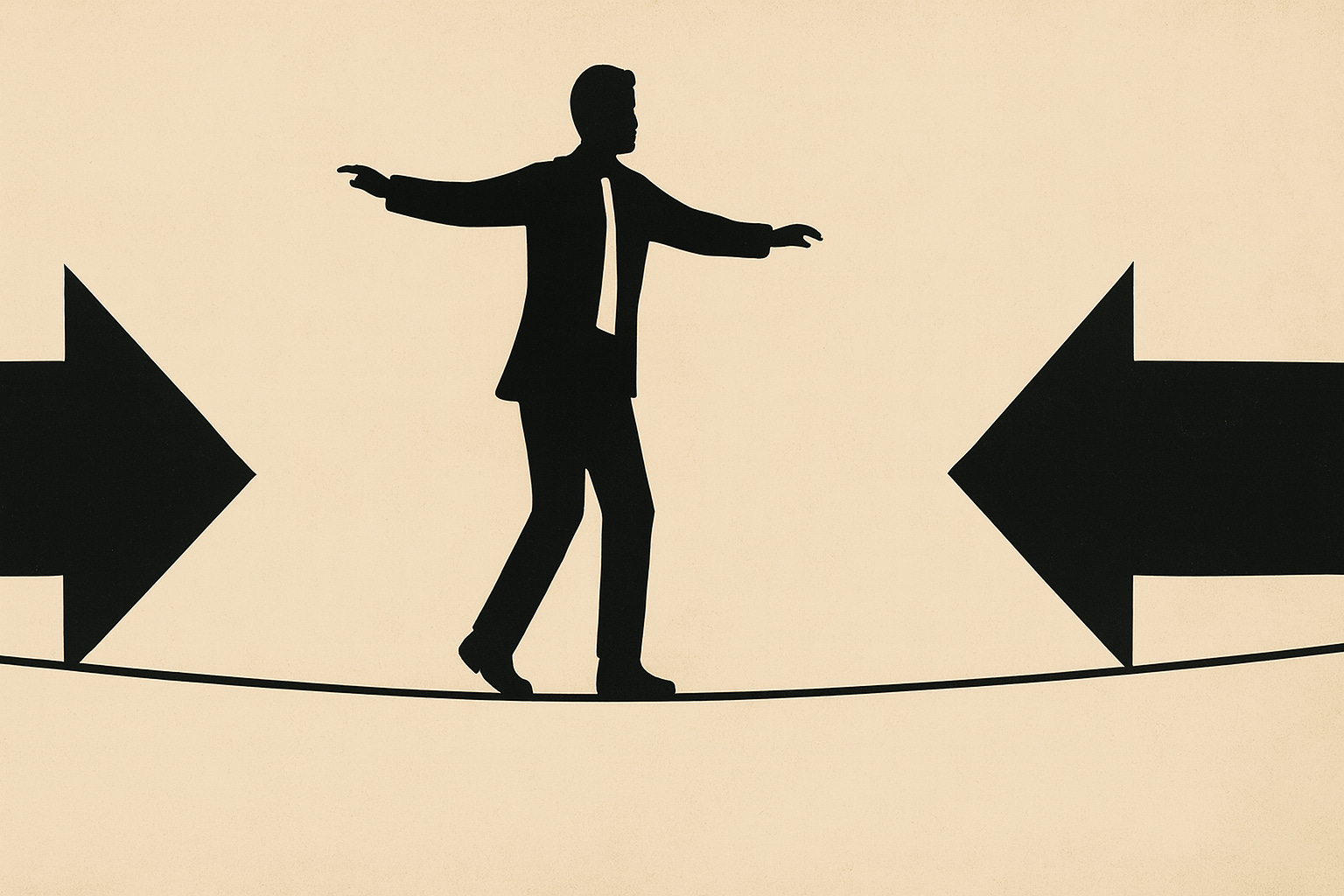
Living in the middle means carrying contradictions. We want belonging and certainty, but we also sense that life is never that simple. We crave clarity, yet know deep down that the world is messy and unpredictable.
That tension is hard to bear. It stirs the urge to choose sides, to silence doubts, to escape the unease of always “figuring it out.” Yet the very impulse to escape is often what keeps us stuck.
That’s why writing, for me, is the door to embrace that tension. It is, in its own way, an act of rebellion.
I don’t feel obliged to be right, or certain, or to perform a role just to earn a place in someone else’s inner circle. I can wrestle with ideas, return to them from a different angle, and even contradict myself.
More importantly, writing is where I can admit—to myself and to the world—that I stand in the middle. And in that admission, others may recognize themselves too, and perhaps find the courage to speak.
But holding tension is never easy. While researching this essay, I found the story of a mother who left the faith she was raised in. Wanting to explain her change of heart to her family, she slipped back into the role of preacher—trying to win them over. Unsurprisingly, it failed.
Like her, when we begin asking questions and living with the uncertainty they bring, those around us often push back. The pressure drives us to attack or defend—but neither response brings us closer.
When we use language only as a weapon to win or persuade, we may feel clever, but we bury the very tension we most need to face. Instead of opening space for reflection and connection, we force it underground. And when it resurfaces—as it always does—it returns heavier, harder to bear.
As Parker Palmer reminds us, tension lives at the heart of our most human experiences:
“The deeper our faith, the more doubt we must endure; the deeper our hope, the more prone we are to despair; the deeper our love, the more pain its loss will bring: these are a few of the paradoxes we must hold as human beings. If we refuse to hold them in hopes of living without doubt, despair, and pain, we also find ourselves living without faith, hope, and love.”
Only by embracing tension do we begin to grasp the full weight of being human.
To most, the middle might look like hesitation. But to me, in a divided world, it’s the truest form of courage.