

“You should watch Severance, that series is pretty cool,” a friend told me.
“I actually just did. But the ending didn’t quite deliver, don’t you think?”
He looked away for a second. “Man, I can’t even remember how it ends.”
“Exactly,” I said.
We both laughed.
At first, it seemed a pretty innocuous interaction. The ending hadn’t landed, so it hadn’t stayed with us. But when I thought back about our exchange later, I started to think that there was more to it than just an unmemorable finale.
As I reflected on other shows I had recently watched, I could barely recall their endings either. For some, I couldn’t even remember the names of the main characters. And I’m not talking about characters with names coined by Leo Tolstoy or other Russian novelists. Fragments remained, but they wouldn’t connect. Everything blurred together.
And then I noticed the same thing elsewhere.
I opened my Kindle and started going through some of the books I had read in the past.
The ones I read without rushing, and followed with written reflection, left something behind. I could recall their key ideas and even some of their stories with clarity. Others I could barely remember. Even their central argument had faded.
Then I opened YouTube and looked through my history. The more recent videos I could still recall, at least a few of their main ideas. But when I went back just a week, it took real effort to bring any of their insights to mind.
So I had to stop for a moment and ask myself:
“What the hell is going on?”
Consumption in the good ol’ days
Back in the early ’90s, you’d stop by a local video rental store, pick a cassette, head home after work, and slide it into the VHS—hoping the previous renter had the decency to rewind it. Then you’d settle into the couch, press play, and for the next couple of hours, the only distractions were the popcorn on your lap or the person next to you who couldn’t help but comment on every scene.
The next day, you’d get to the office, find someone who’d seen it too, and over a cup of coffee, talk through its ideas, how it connected to your own life, laugh at a few moments, and then move on with your day.
Compare that to the experience today.
First, you have to decide which platform to open, with three or four options competing for your attention. You probably start with Netflix, where you’re met with a screen full of choices.
Let’s say you manage to pick something and press play. By the second scene, your phone is already pulling you away. A message from a close friend on WhatsApp. An email from your boss, sent after hours but hard to ignore. Your friend follows up with a YouTube video she expects you to react to; otherwise, your silence starts to mean something. The email lingers too, about something you’re slightly behind on this week.
You open the video just long enough to save it for later, telling yourself you’ll watch it at 2x before going to bed. The email you leave unanswered. But five minutes into the film, your attention drifts back to it, not to act, just to reassure yourself that you’ll handle it tomorrow morning.
All of this happened in a few minutes, and you still have one hour and a half of film to go through.
It’s true that this constant stream of stimuli and the rapid switching it demands have sharpened certain abilities. We’ve become quicker at making micro-decisions, more efficient at scanning information, spotting patterns, and filtering out what doesn’t seem immediately relevant.
But gains rarely come without a tradeoff.
What seems to erode is our ability to stay with something. To hold attention on a single task for long enough to let it unfold. To sit with what doesn’t resolve immediately.
An experiment from 2001 offers an early glimpse of this shift. Two groups were asked to read a short story titled “The Demon Lover.” One read it in a traditional, linear format. The other read a version filled with hyperlinks.
Afterward, the difference was telling. Readers of the hyperlinked version reported greater confusion and uncertainty about what they had just read. One even described the story as “very jumpy.”
That was more than twenty years ago, before social media, before infinite feeds, before everything started competing for your attention at the same time. Back then, simply adding links was already enough to make it harder for people to understand and retain what they were reading.
Now imagine what happens when you add pop-ups, ads, notifications, and a whole range of other things constantly pulling you away from the page.
The constant switching between tasks, however, is just one of the factors making it harder for us to concentrate and retain what we’re consuming.
Overload, speed, and compression
There’s this saying that we take in as much information in one day as someone in the 1800s would in their whole life.
It’s an idea that gets repeated a lot, but it’s not based on any solid historical or scientific evidence.
I think people like to say it because, in a way, it feels true.
Today, you sit down for breakfast and, by the time you finish your coffee, you already know the week’s weather, the geopolitical implications of a decision made an hour ago about the war in Iran, every goal from last night’s Champions League matches, and the recipe for a dish you’ll never cook.
No wonder when you get to the end of the day, you can barely recall one tenth of the information you swallowed.
And behind it all, there’s also a sense of speed driving everything we do.
Our minds are constantly assessing what’s in front of us and trying to figure out as quickly as possible how valuable that information is. If we are seeking entertainment and you don’t create tension or make me laugh within the first five seconds, goodbye my friend, we scroll down and move on to the next piece of content.
When you’re reading a book and a passage doesn’t quite make sense, you move on. Who cares? There’s another chapter waiting, and you still have 52 books to get through this year.
If you spend a Sunday at home doing nothing, a sense of guilt starts to creep in, as if stillness needs to be repaid. The next day becomes a kind of correction, where you try to do ten different things just to make up for it.
And when you hit a challenge at work and can’t move forward smoothly, frustration sets in almost immediately. Instead of reading it as a signal that something deserves more care and attention, you experience it as friction to get past.
One way we cope with this demand for speed is through compression.
Instead of reading books, some people turn to services like Blinkist, which condense entire works into short audio snippets and present it as “the future of reading.” A one-hour interview becomes a five-minute cut. An album is reduced to the one riff everyone is talking about on TikTok.
Now we also have tools like ChatGPT and Claude that are remarkably good at synthesizing anything you want. So why bother looking at the original sources?
The problem in all of this, and one we as writers can’t afford to ignore, is that the attention we use to consume is the same attention we bring with us when we sit down to write.
Attention debt and writing
If a football player spends the whole week eating donuts and then steps onto the field on Sunday, we don’t question why his body can’t perform. We understand that what he consumed shaped what he’s capable of doing. In the same way, when our attention is fed on fragments, speed, overload, and constant compression, we shouldn’t be surprised when our thinking struggles to go deep or to hold something long enough for it to become clear.
Over time, attention adapts to the environment it’s placed in. It learns the rhythm of what it’s exposed to.
You write a sentence, read it back, and before you can even understand what’s wrong with it, something in you wants to leave. Not because the sentence is bad, but because it asks you to stay with it longer, to question it further, to reflect more deeply on what you’re trying to say.
And that’s the point where most of us start to grow impatient with our writing.
It’s hard to find the will to sit inside that fog and think through what you’re actually trying to say when your attention is conditioned to seek fast resolution. The impulse is to move on, to reach for something easier, something that gives you back that feeling of control.
But writing is rarely the act of expressing what is already clear.
It’s the process through which clarity is formed.
And that process depends on a capacity most of us are slowly losing.
The ability to slow down, to focus for a longer period of time on a single idea, to wrestle with experiences that don’t have obvious answers right away, and to do all of that while knowing there are millions of other things competing for your attention.
The people making fortunes on the internet understand that attention is our most valuable resource. Through it, they extract data, sell ads, and shape the narratives we come to inhabit.
If we remain passive, we’ll keep handing away our most valuable resource and find there’s little left when we sit down to write.
What then?
Should you throw your phone in the bin, buy an old Nokia, and move to a cabin in the middle of the forest?
Maybe. But I’m not quite there yet.
What I’ve found is that there are less radical shifts, things you can introduce gradually, that start giving you some of that attention back.
One thing I’ve been experimenting with is putting guardrails on my phone.
Anything that pulls me into infinite scrolling, triggers anxiety, or doesn’t allow me to slow down and think, I cut it off.
For the things I still can’t live without, like messaging people I care about, email, or watching YouTube, I try to contain them within a rhythm:
Messages: check three times a day, after lunch, after work, and after dinner
Email: twice a day, once after lunch, and once just before I end the workday
YouTube: only during lunch and dinner
It’s not perfect. You might even challenge me on whether YouTube belongs in the “need” category. Watching something while eating isn’t ideal either. But it’s at least a constraint, and it already feels better than before.
When it comes to streaming, I don’t really have time for it outside of Tuesday and Friday nights because of workouts and football, so for the most part, that takes care of itself.
Another shift I’ve been taking more seriously is returning to physical space more often.
Twice a week, I go out into nature. There are plenty of parks nearby, so I just get on my bike and go. If I’m reading, even better. It turns something I’d normally do at home into something I can do while getting some vitamin D. And whenever I can, I go surfing. Living in the Netherlands means you don’t get many chances, so when Poseidon decides to cooperate, I make sure I’m in the water.
I’ve also been returning to older rituals.
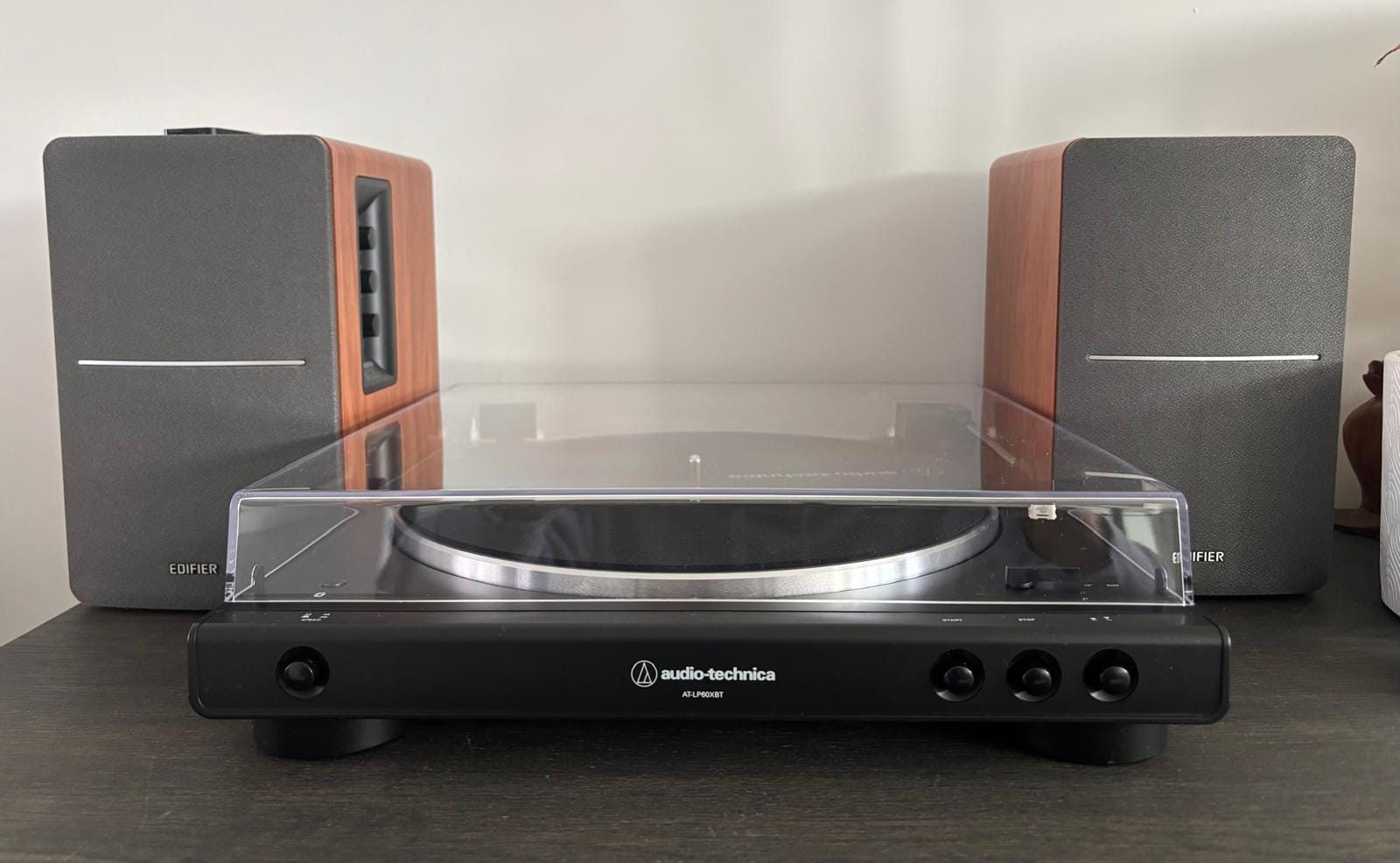
I haven’t gone as far as buying a VHS player yet, but while I still use Kindle for non-fiction, I’ve gone back to physical books for fiction. I also recently bought a turntable, not out of nostalgia, but for the way it changes how I listen. An album on vinyl asks you to stay with it, to experience the whole project as it unfolds — no skipping, no background noise.
And then there’s people.
I’ve been making a conscious effort to step out more, to meet for coffee, organize barbecues in the park, work from a coworking space. My work naturally pulls me into long hours alone in front of a screen, and I’ve started to notice how isolation makes it easier for technology to take over your attention without resistance. So whenever there’s a chance to be around people, to exchange ideas in person, I try not to let it pass.
I’ll be the first to admit that none of this has been smooth.
At the beginning, there was a lot of friction. The kind that feels almost physical, like something in you resists the absence of stimulation. If you’ve ever tried to quit smoking, you’ll recognize it.
My mind is also remarkably good at coming up with excuses when I don’t feel like sticking to these new habits.
So yes, I still fall back into old patterns.
But over time, the movement becomes visible. Two steps forward, one step back still carries you somewhere.
I notice it in small ways. My mind slows down more easily. It settles with less resistance. That constant pressure to keep up, to process everything at once, begins to loosen.
And from that steadiness, something starts to return.
The kind of attention that allows me to reconnect with my creativity and stay with a thought long enough for it to take shape on the page.
I publish essays publicly here.
I send them privately by email — along with two other formats I don’t share on Substack.
If you want to receive the work in that form, you can join the private list: