

“You want to know how many courses he sold?” my friend asked, his voice edged with defiance.
The writer he meant had twenty-six thousand followers on Twitter. So I did some quick math in my head and replied: “Eight hundred… maybe a thousand?”
My friend smirked. “Not even close.”
This guy looked unstoppable. Every post spread like wildfire. Surely the launch had gone big.
“Ten thousand, then?” I tried again.
My friend just shook his head. “Nope.”
I finally gave up. “Alright… how many?”
He leaned in. “One. A single sale.”
I couldn’t believe it. How could someone with that much reach sell only one course? Then the thought hit me harder: my audience on Twitter was twenty times smaller. Was I building a castle of sand too?
When I looked closer, the truth was obvious.
His content was all book summaries. He knew how to stop the scroll, pick the perfect quote, churn out dozens of posts a day.
He had mastered the attention game. But attention can’t buy the one thing that matters:
Trust.
And when he finally asked for more than a click, his audience answered with silence.
At first, this story might look like a fluke. But it wasn’t. His failure wasn’t an exception — it was the natural outcome of a system built to reward attention, not trust. And that system is cracking everywhere you look.
The Collapse of Attention
The endless content. The shrinking attention spans. AI flooding the feed. All signs point in the same direction:
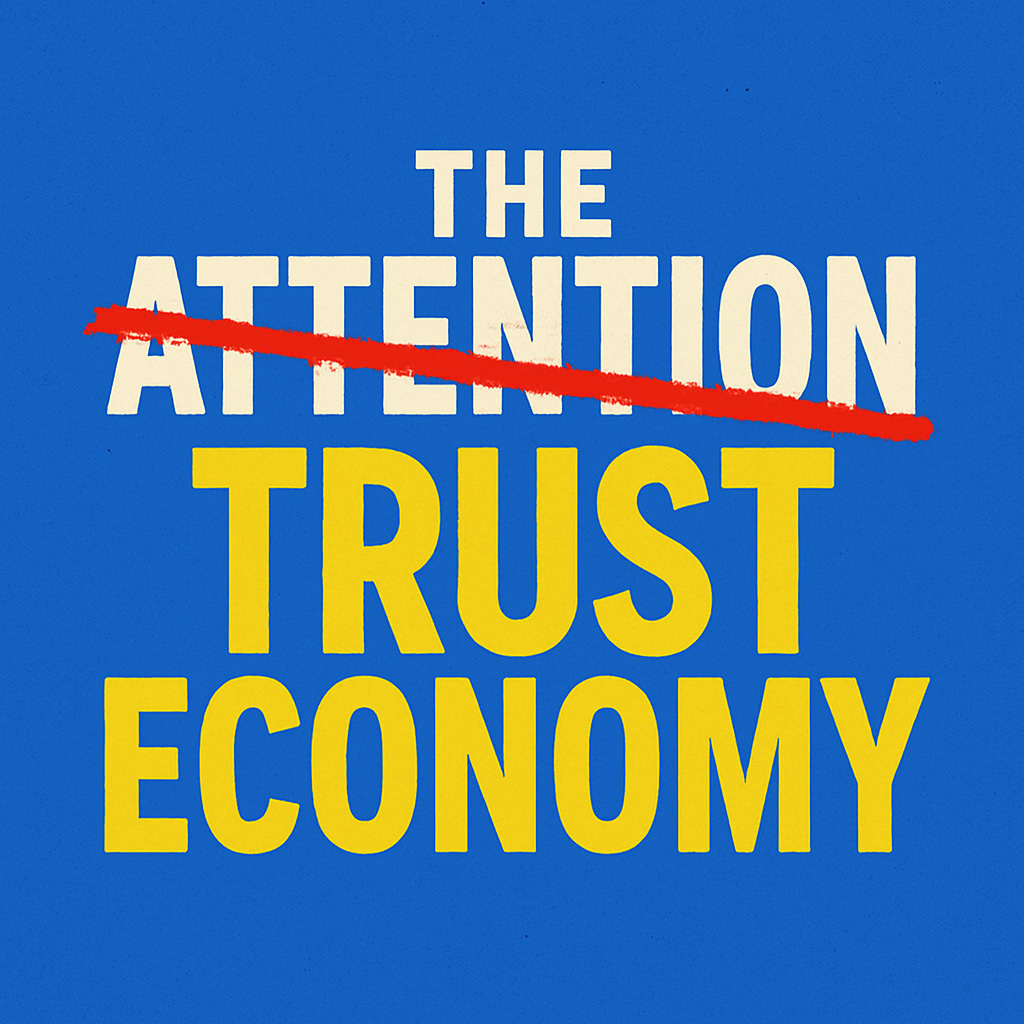
The attention economy is breaking down.
Audiences feel it too. They’re tired of hooks that promise and don’t deliver, headlines that bait and divide, conversations designed to inflame instead of connect.
The model has run its course — and something new is beginning to take shape.
We’re entering a different era: the Trust Economy.
If the attention economy thrived on speed, volume, and reach…
The trust economy is built on depth, authenticity, and connection.
In this new landscape, information alone won’t cut it. People don’t just want more content—they want perspective. A voice they can rely on. A space that feels like home.
And it won’t happen in algorithm-driven feeds. It’s happening in owned spaces, where relationships compound and trust has room to grow.
To understand the shift, look at what’s happening in the feeds today:
500 million tweets are posted every single day.
95 million photos and videos go up on Instagram daily.
720,000 hours of video hit YouTube every day.
People aren’t just consuming — they’re drowning. And AI is raising the tide.
One study found that content production surged 56.7% in a single year after tools like ChatGPT launched—seven times higher than the usual annual increase.
And much of that content isn’t just noise—it’s misleading. Think of newspapers publishing a reading list of books that don’t exist. Or entire rock bands generated by AI. Or scammers using deepfakes to promote fraudulent schemes.
And if the sheer volume weren’t enough, the gatekeepers often make it worse: influencers exploiting followers for profit, media outlets scripting the news to fit their agendas. No wonder only about 22% of people globally say they trust social media.
But in this climate of distrust, something new is taking root.
A decade ago, with endless free content at our fingertips, the idea of paying for writing seemed absurd—unless you were The New York Times.
Today, more than 5 million people pay for at least one Substack subscription to read the independent voices they trust.
Private communities are surging too. Discord hit 259 million monthly active users in 2025—a 72% jump since 2022.
The signal is unmistakable: audiences are leaving the noise of the feed for spaces where they can find depth, belonging, and voices they trust.
That’s why Substack, podcasts, niche newsletters, and private communities are thriving: they free creators from the algorithm’s chokehold. Here, creators don’t need hyperbolic headlines designed to spark outrage or envy. They can slow down, speak honestly, and build work that lasts — without sacrificing the quality of their ideas.
The Courage to Lead
Creating a safe space is the first step toward building trust. But behind this new paradigm lies something deeper:
You have to be willing to lead.
“Leadership” is a word thrown around so often it’s lost its edge. Real leadership isn’t about titles or follower counts. It’s about one simple commitment: the courage to name what’s broken and create space for something new to emerge.
You need to reveal the incentives, players, and systems that keep the old order alive — while at the same time sketching the alternative, however rough, and building it in real time.
And no one does this alone. Change requires participation.
It’s not enough to publish a newsletter and walk away. Leaders listen. They ask questions. They invite readers into the process, until the vision becomes something shared. It’s about moving away from the concept of audience (passive) and start embracing the idea of community (active.)
This is the work the attention game denies you. It traps you on a treadmill of content — producing more, faster — until you’re too distracted by numbers to create real change.
But the truth is, if you earn the trust of even 100 people, you already hold the power to create meaningful change — for them and for yourself.
So the question is no longer abstract. It’s personal:
Will you keep chasing “engagement” in a game that’s already collapsing?
Or will you begin building trust — your own space, your own voice, your own community — where the work you create can actually last?
Join the Conversation
Trust doesn’t grow in isolation; it grows in conversation.
So I want to hear from you. Do you see these shifts happening in your own world? What changes do you hope to create through your writing?
Hit reply and share your thoughts. Your perspective matters.
But still, just because you are on Substack which bother way, looks more and more like a social media platform, means people don’t write with a.i. or even on a website.
I agree that people crave for depth that’s for sure.
Good insights, thanks