

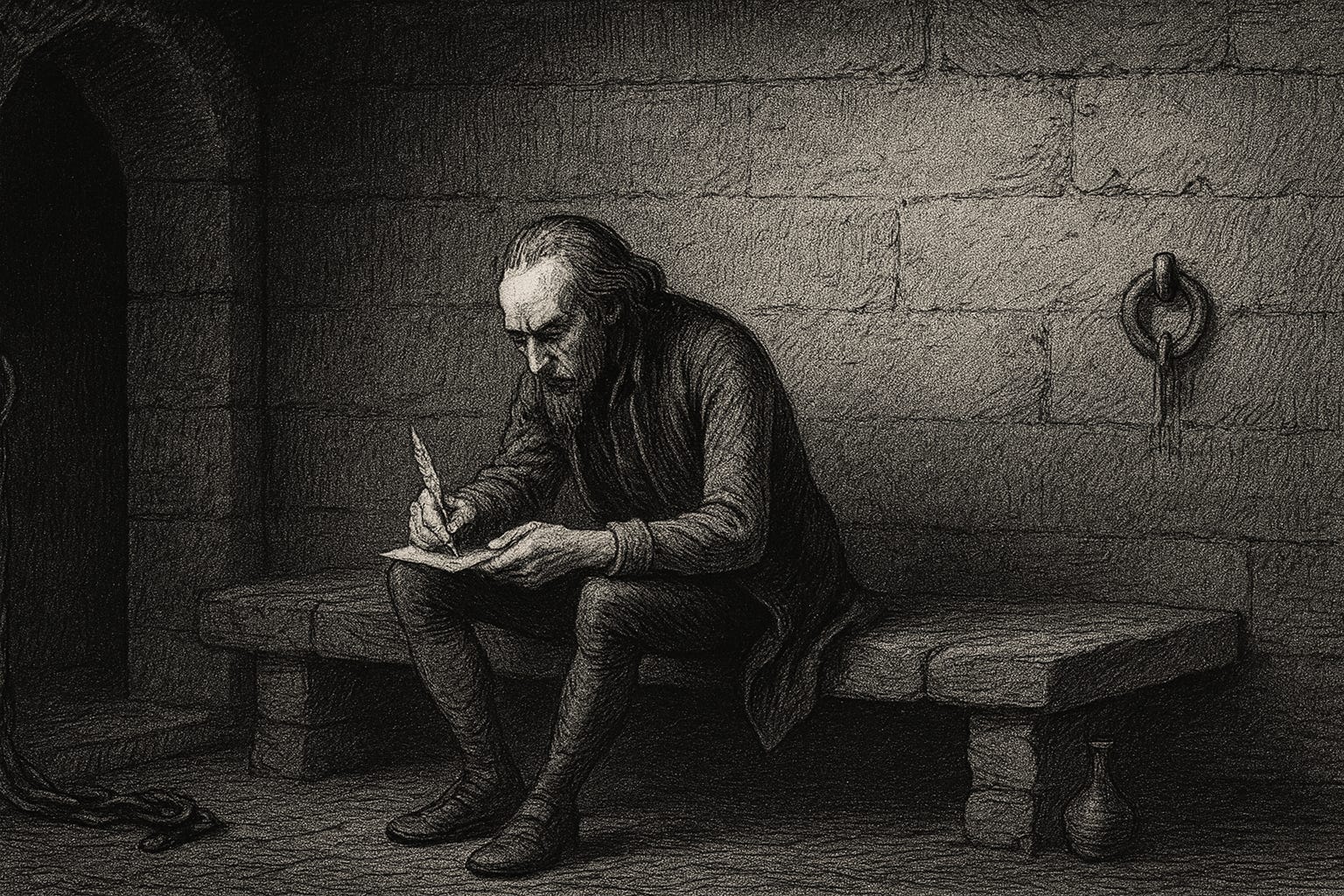
In 1726, a single insult changed the course of a young writer’s life. François-Marie Arouet — already writing under the name Voltaire — was arrested and thrown into the Bastille, not for plotting against the state, but for a cutting remark at the expense of a powerful noble. What began as a duel of words ended with iron bars, and an exile that would shape him into one of the most formidable voices of the Enlightenment.
By the mid-1720s, Voltaire was in his early thirties, gaining fame in Paris as a sharp-tongued poet and playwright. His tragedies were staged at the Comédie-Française, the state theatre where aristocrats, courtiers, and intellectuals gathered. The theatre was more than entertainment; it was a battlefield of reputation. Nobles flaunted their rank, and writers tried to carve out a place with wit — dangerous territory for someone of middle-class birth like Voltaire.
It was there, in 1725, that Voltaire crossed paths with Chevalier de Rohan, a member of the powerful Rohan family. Rohan, irritated by the young writer’s growing influence, tried to put him in his place. In front of others, he sneered: “And who is this Arouet?” — dismissing him by his bourgeois family name.
Voltaire did not let it pass. He shot back a reply that cut just as deep:
“I am beginning my reputation, monsieur, while you are ending yours.”
A man without noble birth had publicly humiliated one of France’s great families. Rohan was enraged. Days later, hired thugs ambushed Voltaire and left him bloodied in the street.
But instead of bowing to intimidation, Voltaire did the unthinkable: he challenged Rohan to a duel.
It was a fatal misstep. In the rigid order of France, a commoner could not raise his sword against a noble. Rohan never needed to fight. He used his influence instead. On April 17, 1726, Voltaire was arrested and taken to the Bastille, imprisoned without trial.
He remained there for several weeks. With the threat of indefinite confinement hanging over him, Voltaire struck a bargain: he would accept exile in England.
What looked like defeat was, in truth, a turning point. In England, Voltaire encountered Locke’s philosophy, Newton’s science, and the relative freedoms of English society. When he returned to France three years later, he carried with him not only the scars of insult and imprisonment, but also the intellectual arsenal that would make him the fiercest critic of tyranny and superstition in Europe.
The Muddy Arena
What nearly cost Voltaire his freedom was not treason or conspiracy, but the decision to step into the arena — to speak openly, to defend his place with words instead of silence. In his time, the arena was brutal. A clever remark could get you beaten, exiled, or worse. Class divisions were absolute, gatekeepers controlled who could speak, and survival often meant disguising ideas behind wit and allegory.
Today, the arena looks different. With the rise of the internet and social media, anyone can step forward without fear of prison or exile. The dangers are fewer, the barriers lower.
And yet, despite this freedom, I see the same pattern repeated: writers with real knowledge, with fresh ideas, who choose not to enter the arena at all.
When you ask them why, their answers sound reasonable. The one I hear most often is: “The arena is muddy.”
Stepping into it means wrestling with distraction, outrage, and performance. What unsettles them isn’t just the dirt — it’s the fear that the mud might seep in and change who they are.
When they look at the winners, the ones at the top, they see archetypes they don’t want to emulate. They see people who have reshaped themselves into images they must endlessly maintain, trapped in cycles of applause and validation.
Behind much of this is the invisible hand of the algorithms — the modern gatekeepers. They push people to sharpen their edges for more clicks, to strip away nuance because it doesn’t travel fast enough.
And so the question nags: “Do I really want to bend myself into this shape just to play the game?”
Being your true-self is already difficult in smaller circles — with colleagues, friends, even family. Now imagine scaling that to the internet, where you don’t know who’s on the other side of the screen, and where hostility is only a comment away.
But that’s only one reason. The other common refrain is: “What I have to share is already being said by many.”
And in a way, it’s true. Knowledge today is abundant. A quick search will surface hundreds of voices circling the same themes. Some of them already command massive audiences. Against that backdrop, it’s easy to feel redundant.
So they hesitate, thinking: “Why bother? Who cares what I have to say?”
On the surface, these reasons sound convincing. But I’ve noticed that beneath them, something else is at work — something more powerful than mud, noise, or the risk of redundancy.
The Hidden Obstacle
When Voltaire refused to stay in his place and chose to speak his mind, he wasn’t only risking prison. He was risking being cast out by a society unwilling to hear voices like his.
Every society has ways of keeping people in line. In Voltaire’s time, it was a rigid order of rank and class, enforced through a simple game: reward and punishment.
Ours may look different, but the mechanism hasn’t changed. Stay inside the lines and you’re rewarded. Step outside and you’re punished.
Compliance earns applause. “Good boy, well done.”
But try doing things your own way, and the labels arrive: stubborn, naïve, unreliable.
And those labels carry consequences…
A family’s lack of understanding. A teacher’s low marks. A boss who keeps you stuck on the ladder. Friends who quietly close the circle around you.
Which means the decision to enter the arena isn’t just about mud, or about wondering if your ideas are original.
It’s about something deeper:
The fear of being punished for showing who you truly are.
Once you get yourself out there and drop the mask, you may find people don’t like what they see. That the acceptance — even the recognition — you once earned by feeding someone else’s value system disappears when you begin to live by your own.
This is why many writers who dip a timid toe into the arena retreat at the first blow. Not because the mud is too dirty, but because the weight of authenticity can feel heavy.
So it’s easier to linger in the dream of being a writer than to actually write. In the dream, you can’t be punished. In the dream, you have full control of the story.
And with that, the forces keeping you outside the arena win. Once again.
The Costly Choice
Every age has its arena. For Voltaire, it was a theatre where wit could draw blood, a duel of words that could end in chains. For us, it’s a digital stage where the punishments are softer, but the fear is the same: the cost of being seen for who we are.
So the real question isn’t whether the arena is muddy or whether your ideas are already taken. The question is simpler, and harder:
What happens if you never bring your true voice into the open?
What is lost — not to algorithms or to audiences — but to yourself?
Because at some point, silence becomes its own kind of prison. And unlike the Bastille, it has no guards, no iron bars, no forced exile. It’s a cell we carry within us, built from the safety of pretending.
In the end, the lock is only fear. The key, only risk.
And the choice — to step in or stay out — is yours.
Voltaire stepped in and paid dearly. But what he gained outweighed the cost: the freedom to live as himself, and the chance to leave a mark only he could make.