

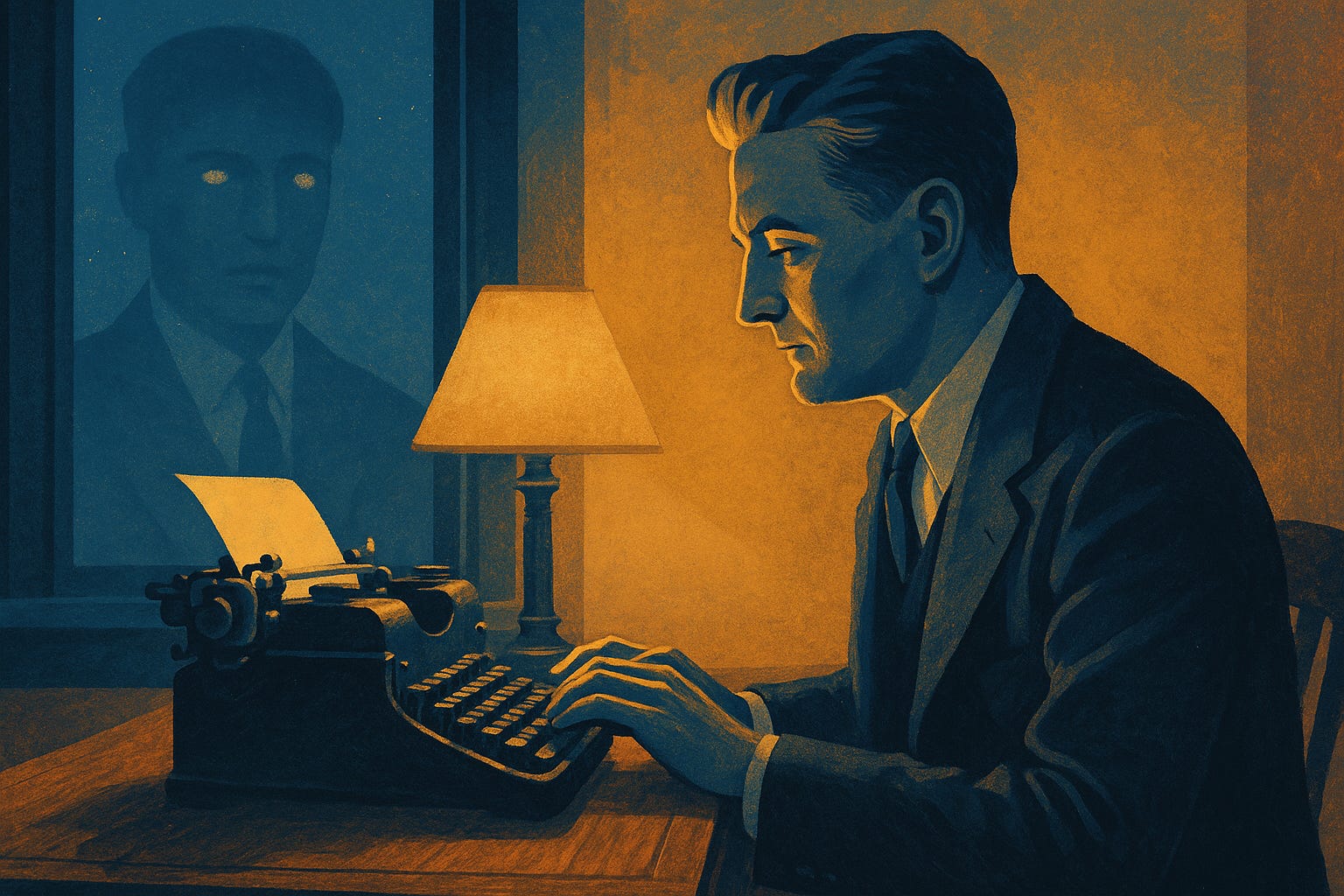
When F. Scott Fitzgerald published This Side of Paradise in 1920, he was only 24 years old. The book was an instant sensation—overnight, he became the voice of a generation. He had money, fame, the love of Zelda, and the illusion that he had “made it.”
But this is where the unraveling began.
Fitzgerald believed, deeply, that his identity and purpose were inseparable from literary greatness. And yet, he feared that he had peaked too early. After The Great Gatsby failed commercially in 1925, he descended into self-doubt and bitterness. He’d poured everything into that novel—his craft, his vision, his pain—and it had landed with a thud. Critics shrugged. Sales were underwhelming.
Disillusioned by Gatsby’s poor reception, Fitzgerald confided in a letter to a friend:
“The dream is gone. Something is lost. I no longer believe in Gatsby.”
That line wasn’t just about the book. It was about himself. Gatsby’s story was Fitzgerald’s story: the belief that love, identity, and redemption could be earned through brilliance and success—and the heartbreak of realizing that even your best work might not be enough.
In the years that followed, Fitzgerald spiraled. He became dependent on alcohol. He spent years writing and re-writing Tender Is the Night, trying to prove that he still had it. His wife Zelda suffered a mental breakdown and was institutionalized. He became isolated, broke, and riddled with guilt.
In his personal essays, Fitzgerald began to chronicle his fall. One of the most haunting is The Crack-Up, where he writes:
“Of course all life is a process of breaking down, but the blows that do the dramatic side of the work—the big sudden blows that come, or seem to come, from outside—the ones you remember and blame things on and, in moments of weakness, tell your friends about, don't show their effect all at once.
The essay shattered the myth of the glamorous writer. It revealed a man undone—not from lack of talent, but because he couldn’t separate his self-worth from his creative validation.
Fitzgerald died of a heart attack at 44, believing he was a failure.
The Great Gatsby wouldn’t become a classic until years later.
The Validation Trap
Most of us won’t write a masterpiece at 24. But there's one thing we do share with Fitzgerald:
The craving for creative validation.
We daydream about who we might become one day. We imagine recognition, admiration from our peers, and messages from readers saying "Your work changed me." We want to feel like the title "writer" fits. That when we say it aloud, others will nod in agreement.
And so, every time we sit down to write, we invite that imagined future into the room. We ask it to sit beside us, watch over our shoulder, and give its approval.
But when we hit publish, reality knocks on the door.
And the dissonance stings: "Is anyone reading this? Is it any good? Is it worth it?"
Over time, those questions don’t just linger in your mind. They begin to show up on the page.
You start writing. You try to focus. Then, slowly, something real begins to surface—your contradictions, your grief, your unspoken desires. And just as you get close, your body urges you to pull away. You reach for your phone. Open a tab. Check your email.
The nervous system registers the threat: "If I go there again and no one cares, it might hurt too much to return."
So you stall. You self-edit. You shrink.
The page becomes a mirror—reflecting the distance between who you are and who you think you need to be.
That gap is where the craving for validation takes root.
And the longer we tie our worth to the response, the harder the act of writing becomes.
Because at a certain point, it’s no longer just about being read—it’s about being seen.
The Identity Trap
Writing—especially personal or meaningful writing—isn’t just a form of self-expression. It’s also a form of self-revelation. And that’s where the trouble begins.
Somewhere in the back of our minds, we know that honest writing doesn’t just change our schedule or routine—it changes us.
It can lead us somewhere we didn’t expect. It can stir up things we’ve managed to keep quiet for years. Longings we haven’t named. Beliefs we no longer recognize. Versions of ourselves we’re not sure we’re ready to leave behind.
And when that happens, the subconscious resists. "Do you really want to go there?"
Procrastination steps in—not as laziness, but as emotional armor. It’s not that you don’t care. It’s that you know: if you write it down, if you name it honestly, something shifts. And once you see it clearly, you can’t unsee it.
That's the part that's often not talked about: the grief that comes with growth. That becoming more yourself often requires letting go of the selves that once kept you safe.
“We write to taste life twice,” said Anaïs Nin. But the second taste can be sharper. More honest. Harder to swallow.
And this inner tension is rarely experienced in isolation. It unfolds within a culture that values performance, clarity, and consistency. A culture that doesn’t just ask you to write—it asks you to become a writer. A recognizable type. A voice that can be packaged, repeated, scaled.
So while part of you wants to explore, another part feels the pull to refine, to present, to fit a shape.
Not just for readers—but for algorithms, for peers, for the quiet approval of imagined eyes.
And this outer pull deepens the inner dilemma: “What happens if I change? What happens if the self I reveal no longer matches the self I’ve constructed?”
Because once you write something true, something irreversible takes place. And the question you’re left with—each time you return to the page—isn’t just technical or stylistic.
It’s existential.
Stay the same—or tell the truth?
And in the uncertainty that follows, comparison creeps in.
The Comparison Trap
You look at the writers you admire, and they seem to have it all.
Unique writing style. A deep psychological and philosophical lens. Flow. Ideas that get you thinking for days.
So you do the thing we all do. You compare.
But it’s never a fair fight.
You compare your messy draft to their polished prose. Your private struggle to their public praise.
And you forget that they, too, once stared at the blank page with doubt. That their voice was shaped by wandering, not certainty. That even now, they might fear their next piece won’t land.
But comparison doesn’t just distort your perspective. It turns you into a curator of other people’s voices. And over time, it silences your own.
You stop asking what you want to write and start chasing what seems to work for them.
You mimic their tone. Their structure. Their rhythm. You treat their path as a template instead of a lens. And in doing so, you drift further from the source.
You forget the goal isn’t to sound like someone else.
It's to sound like you.
And you can’t do that while measuring every sentence against someone else’s highlight reel.
The antidote isn’t to stop admiring great writing. It’s to stop using it as a mirror.
Look outward for perspective. But return inward for permission.
That’s where your real voice waits.
The Gift of Obscurity
When I worked in startups, I used to hear the David vs. Goliath analogy all the time.
Big companies had the resources, the talent, the brand recognition. But we had something they didn’t:
Agility.
We could move fast. Ship ideas without three layers of approval. Talk directly to customers. Fix problems with one honest email. We didn’t have the pressure to be perfect—so we could experiment, learn, and adapt in real time.
Writing works the same way.
When you’re still under the radar, you’re not weighed down by expectations. No one’s watching closely. You’re not protecting your reputation. You’re finding your voice.
Which means you can take creative risks. Contradict yourself. Try a format that flops. Write something strange and true and not worry about how it lands.
That freedom is a rare gift.
Fitzgerald didn’t have it. After his early success, every sentence had to prove something. Every novel had to justify the myth. He was no longer writing to explore—he was writing to defend his reputation. That’s a heavy weight to carry.
But you’re not there. Not yet.
And that gives you space to find your voice before others start defining it for you.
The early days of writing are like creative adolescence. Messy. Full of false starts and surprising turns. But they’re also honest in a way polished work can never be.
So let go of the pressure to arrive. Let your present self lead—the version still asking questions, still figuring it out.
Sure, you’ll wander. But if you pay attention to what stirs you, what unsettles you, what makes you feel alive—that’s your direction.
As Fitzgerald once said:
“The test of a first-rate intelligence is the ability to hold two opposed ideas in the mind at the same time, and still retain the ability to function.”
So hold both: the vision of who you want to become—and the freedom to be exactly where you are.
Write. Publish. Notice.
That’s the work. And that’s enough to keep going.